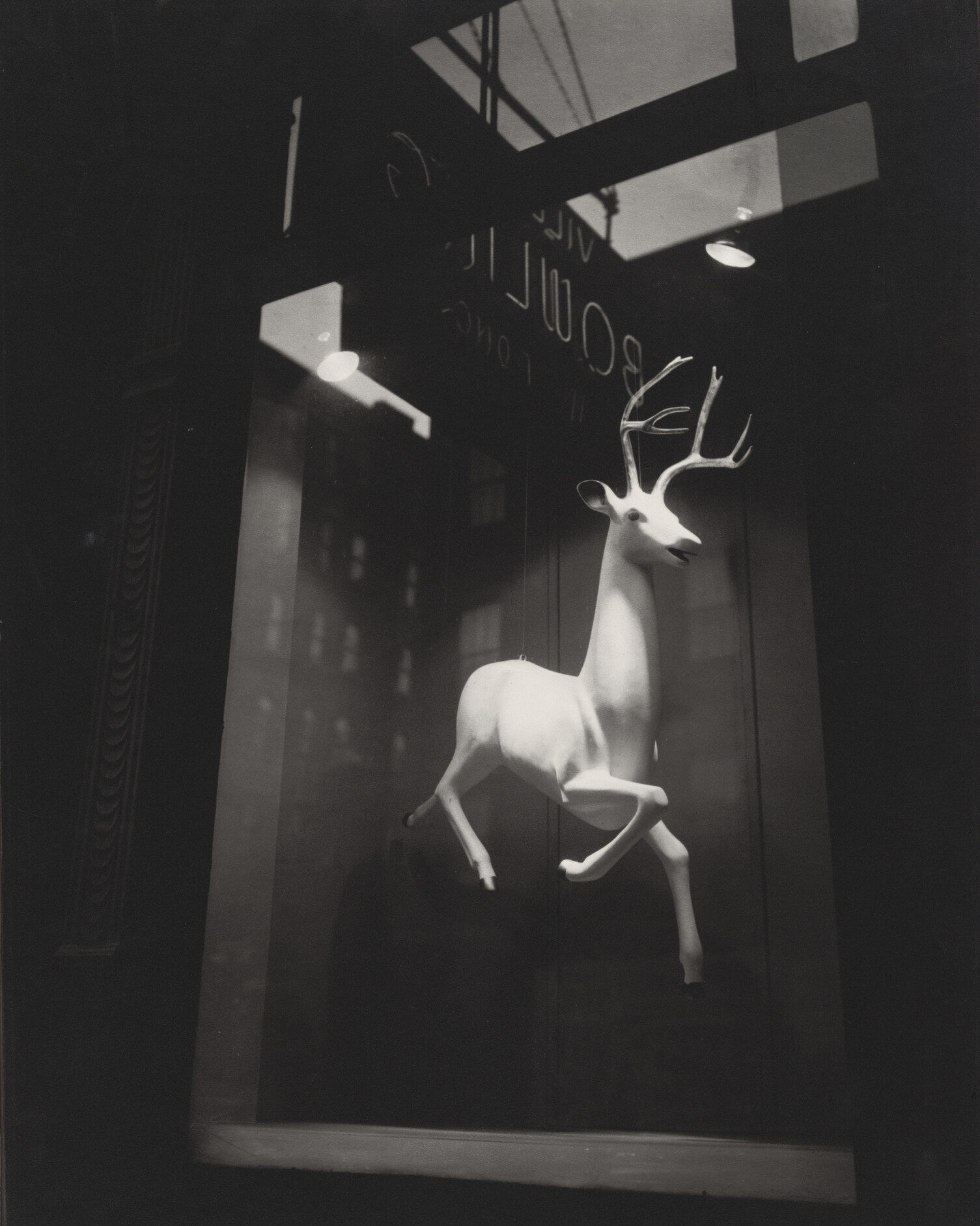
Berenice Abbott
Berenice Abbott (1898–1991, born Springfield, Ohio) was a photographer whose documentary work in New York City during the 1930s produced one of the most important photographic records of American urban life in the twentieth century, and whose tireless advocacy for the medium helped establish photography as a legitimate art form in the United States. Moving to New York in 1918 and then to Paris in 1921, she trained as a darkroom assistant under Man Ray and subsequently established herself as a portraitist of the Parisian avant-garde, producing celebrated studies of James Joyce, Jean Cocteau, André Gide, and many others.
In Paris she also discovered the work of Eugène Atget, the French photographer whose documentation of a vanishing Paris had gone largely unrecognized during his lifetime. Abbott acquired his archive after his death in 1927 and spent years championing his work, eventually securing its preservation at the Museum of Modern Art in New York. Returning to New York in 1929, she embarked on her landmark project Changing New York, an eight-year undertaking that documented the city’s rapid transformation through a series of formally rigorous, historically precise photographs published by the Federal Art Project in 1939.
Her work is held in the collections of the Museum of Modern Art, New York, the Smithsonian American Art Museum, and the Metropolitan Museum of Art.