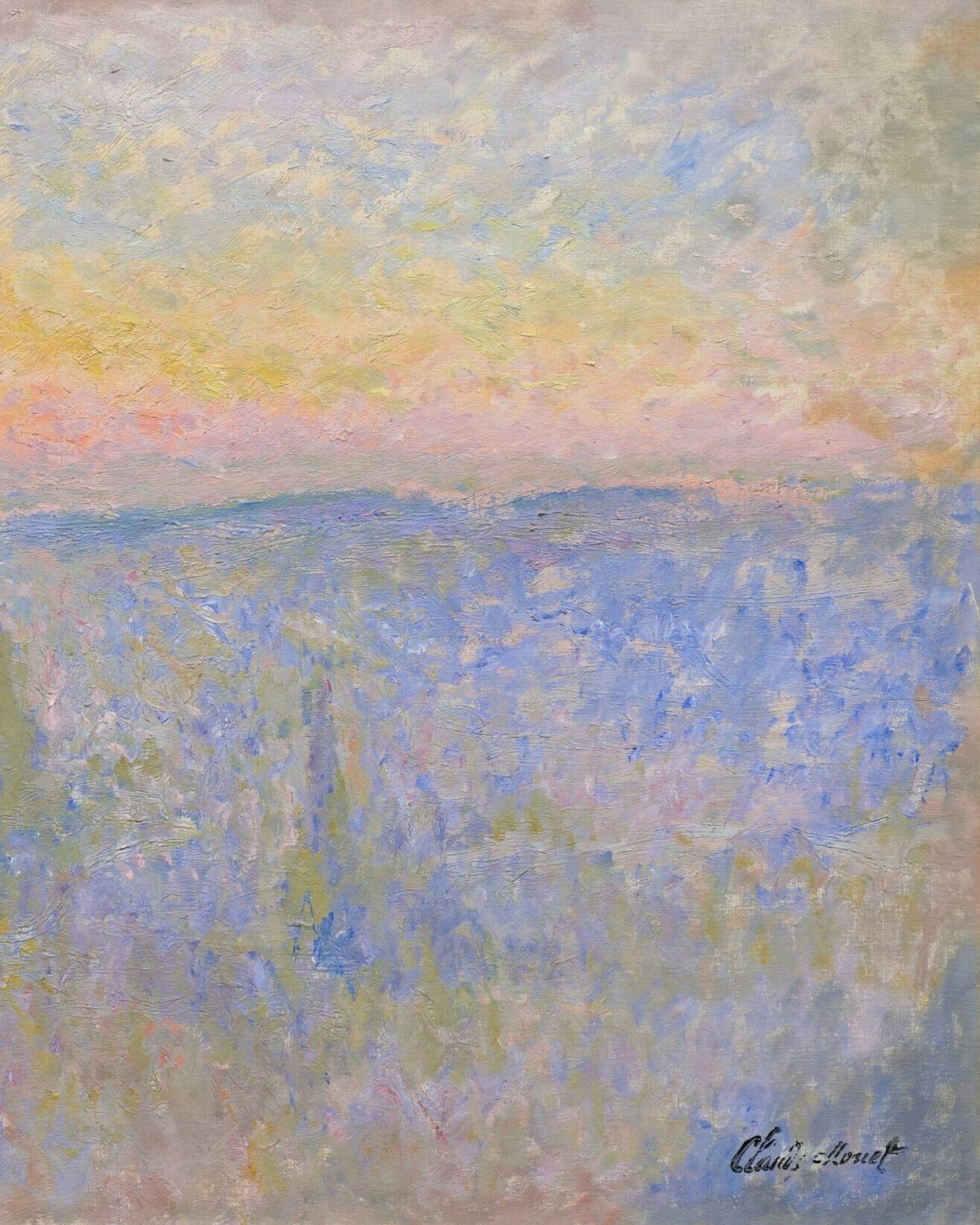
Claude Monet
Claude Monet (1840–1926, born Paris, France) was a painter whose sustained investigation of light, color, and the transient effects of atmosphere on the natural world made him the central figure of Impressionism and one of the most consequential artists in the history of Western painting. A co-founder of the Impressionist movement, Monet helped organize the landmark first Impressionist exhibition in Paris in 1874, a show that gave the movement its name and established a new relationship between the painted surface, observed nature, and the act of visual perception.
Over a career spanning seven decades, Monet returned obsessively to particular subjects, including the River Seine, the cliffs at Etretat, hayfields at dawn and dusk, the cathedral at Rouen in different lights, and the water garden he created at Giverny, producing series of paintings that explored how the same subject changes under different conditions of light and season with a patience and rigour unmatched in the history of the medium. His late Water Lilies series, large canvases painted at Giverny from the 1890s through the 1920s, are among the most radical and influential achievements in Western art, their dissolution of solid form into pure colour and reflection anticipating the concerns of Abstract Expressionism by a generation.
His work is held in virtually every major museum in the world, with the largest concentration of the Water Lilies series permanently installed in the Orangerie in Paris, as he intended.