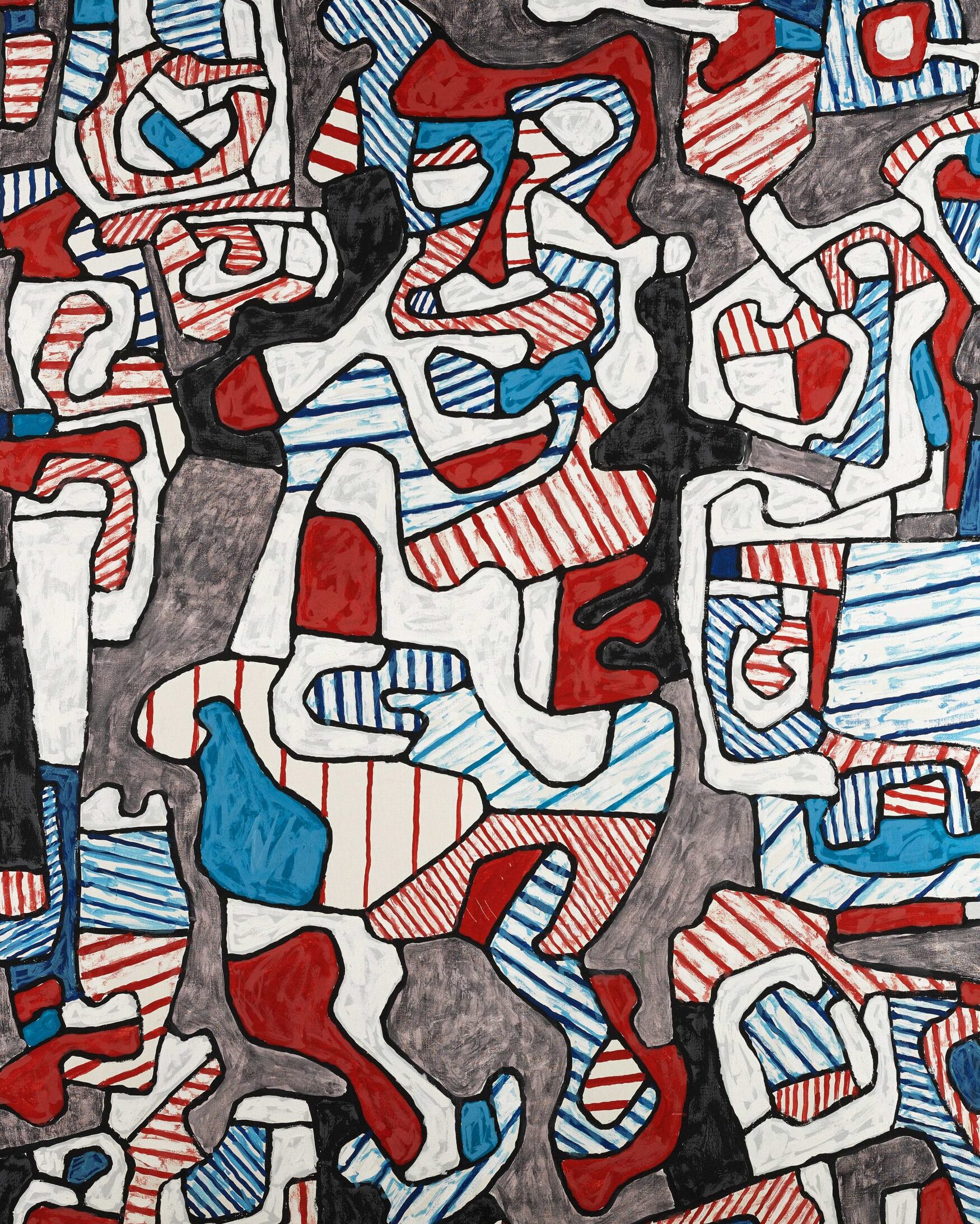
Jean Dubuffet
Jean Dubuffet (1901–1985, born Le Havre, France) was a painter, sculptor, and printmaker whose radical rejection of conventional aesthetics made him one of the most provocative and consequential figures in postwar European art. After brief studies at the Académie Julian in Paris, he spent nearly two decades in the wine trade before committing fully to painting in 1942. The late start produced a body of work of extraordinary range and restless invention across the final four decades of his life.
His most enduring contribution was the coining and theorizing of Art Brut, a term describing work produced by children, self-taught artists, and those outside cultural institutions, whose directness and vitality he believed offered a more authentic form of expression than the traditions of high culture. His own paintings absorbed these qualities, incorporating tar, sand, gravel, and asphalt into thick impastoed surfaces scratched with crude, energetic marks that deliberately subverted conventional standards of beauty and finish. In the 1960s he developed the Hourloupe series, a graphic language of interlocking black-outlined forms extended into large-scale sculptures and architectural environments of striking originality.
His work is held in the permanent collections of the Museum of Modern Art, New York, the Centre Georges Pompidou, Paris, the Metropolitan Museum of Art, and the Art Institute of Chicago.