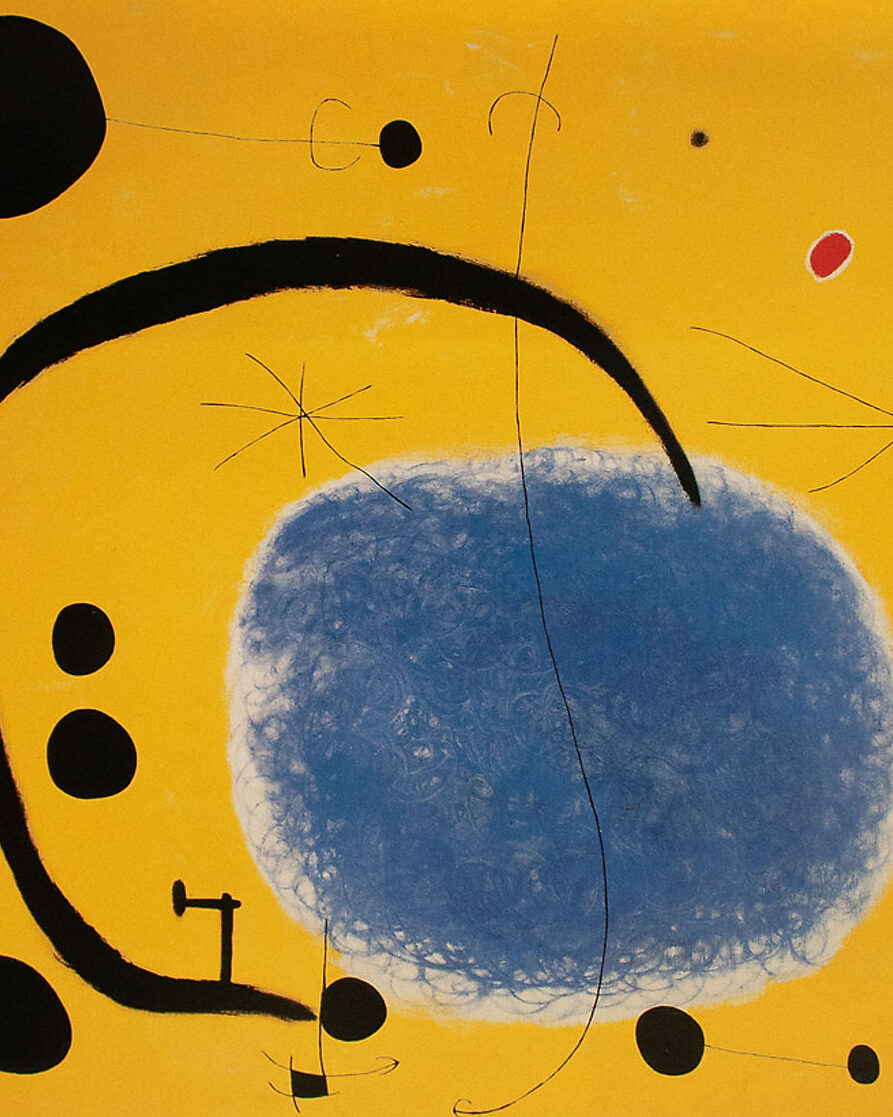
Joan Miró
Joan Miró (1893–1983, born Barcelona, Spain) was a painter, sculptor, and printmaker whose singular visual language, combining biomorphic forms, bold primary colours, and a poetic spontaneity rooted in the unconscious, placed him among the most original and influential artists of the twentieth century. Initially associated with Surrealism, Miró maintained a lifelong independence from any single movement, developing across seven decades a body of work remarkable for its sustained inventiveness and its capacity to hold together the playful and the serious, the intimate and the monumental.
Moving between Barcelona, Paris, and his family farm in Montroig, Catalonia, Miró developed close friendships with Picasso, Calder, and Duchamp and participated in the major exhibitions of the European avant-garde throughout the 1920s and 1930s. His deep attachment to Catalan culture and landscape informed his work throughout his life, and his commitment to his homeland led him to co-found the Joan Miró Foundation in Barcelona in 1975, an institution dedicated to the support of experimental art and the preservation of his legacy.
His work is held in collections globally, including the Museum of Modern Art, New York, the Centre Georges Pompidou, Paris, the Tate Modern, London, and the Fundació Joan Miró, Barcelona.