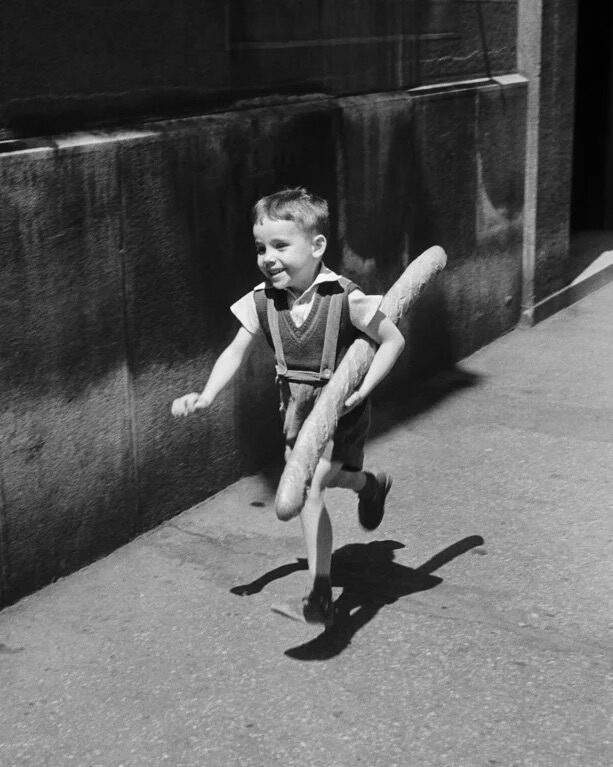
WILLY RONIS
Willy Ronis (1910–2009, born Paris, France) was a French photographer whose lyrical and humanist vision of post-war Paris and Provence placed him alongside Henri Cartier-Bresson and Robert Doisneau as one of the defining voices of twentieth-century French photography. Raised in Montmartre, where his father ran a portrait studio, Ronis came to photography reluctantly, taking over the family business when his father fell ill in 1932 before setting up as a freelance photographer after his father’s death in 1936. His decades-long documentation of Parisian working-class life, conducted through the Rapho agency and published widely in Life, Paris Match, and Vogue, established him as one of the great humanist photographers of his generation.
His most celebrated image, Nu provençal (1949), a nude of his wife Marie-Anne washing at a basin with a garden visible through an open window, is among the most reproduced photographs in French cultural history. He was included in Edward Steichen’s landmark Family of Man exhibition at the Museum of Modern Art in 1955 and received the Gold Medal from the Venice Biennale in 1957, the Grand Prix des Arts et Lettres for Photography in 1979, and the Prix Nadar in 1981.
His work is held in the permanent collections of the Bibliothèque Nationale de France, Paris, and in major public and private collections throughout Europe and the United States.