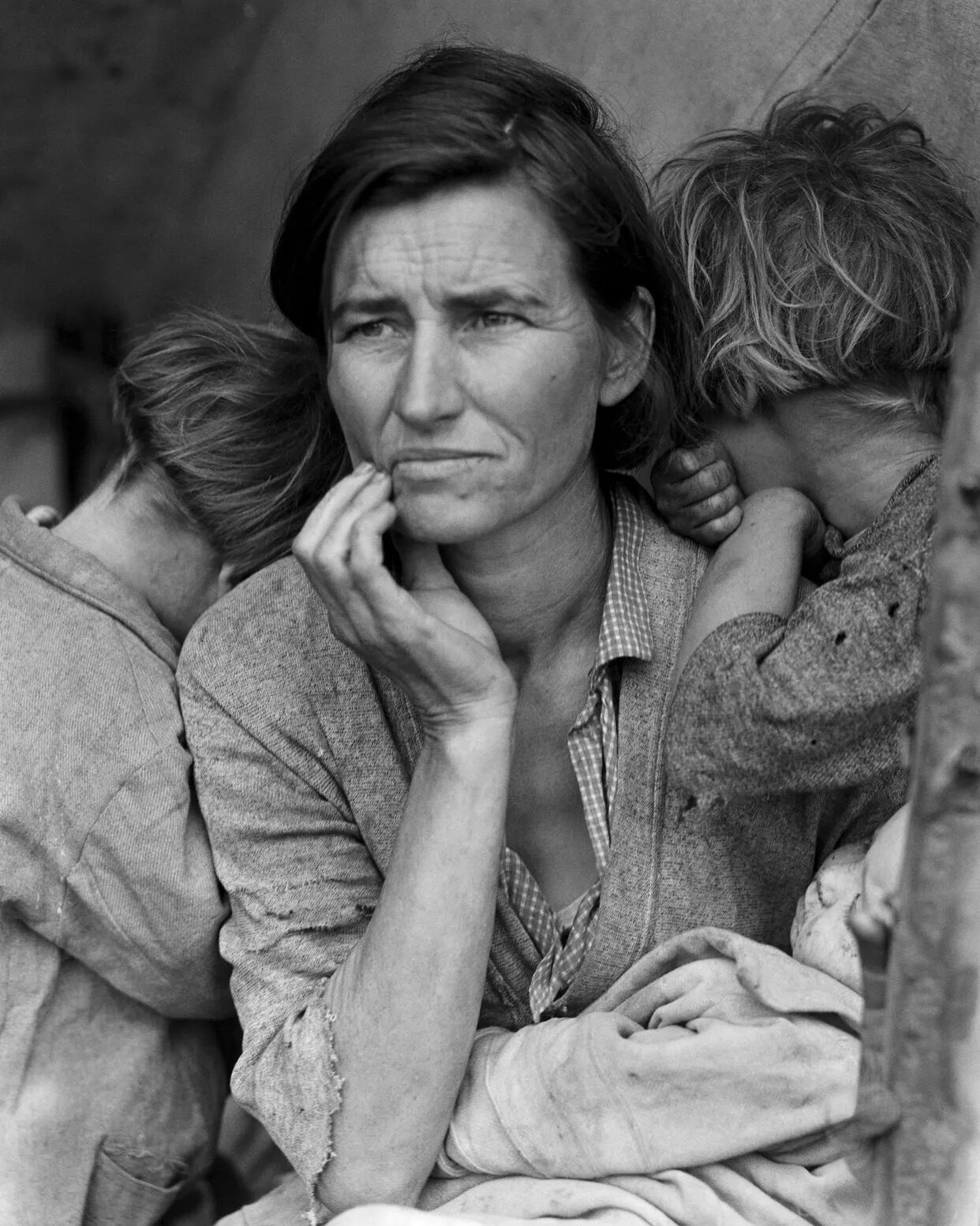
Dorothea Lange
Dorothea Lange (1895–1965, born Hoboken, New Jersey) was a documentary photographer whose images of poverty, displacement, and resilience during the Great Depression and the forced internment of Japanese Americans during the Second World War produced some of the most powerful and historically significant photographs ever made. Initially trained as a portrait photographer in New York before relocating to San Francisco in 1918, Lange turned her lens to the streets during the Depression, producing images of unemployed men and dispossessed families with a directness and empathy that attracted the attention of the Farm Security Administration, who employed her from 1935 onward.
Her most celebrated photograph, Migrant Mother (1936), made in a pea-pickers’ camp in Nipomo, California, became the defining image of the Depression and one of the most reproduced and widely recognized photographs in the history of the medium. During the Second World War, Lange documented the forced relocation of Japanese Americans with unflinching moral clarity, producing a body of work that the government attempted to suppress for its critical implications. Her photographs from this period were not exhibited until decades later and remain among the most important documents in the history of American civil rights.
Her work is held in the collections of the Museum of Modern Art, New York, the Oakland Museum of California, and the Library of Congress.