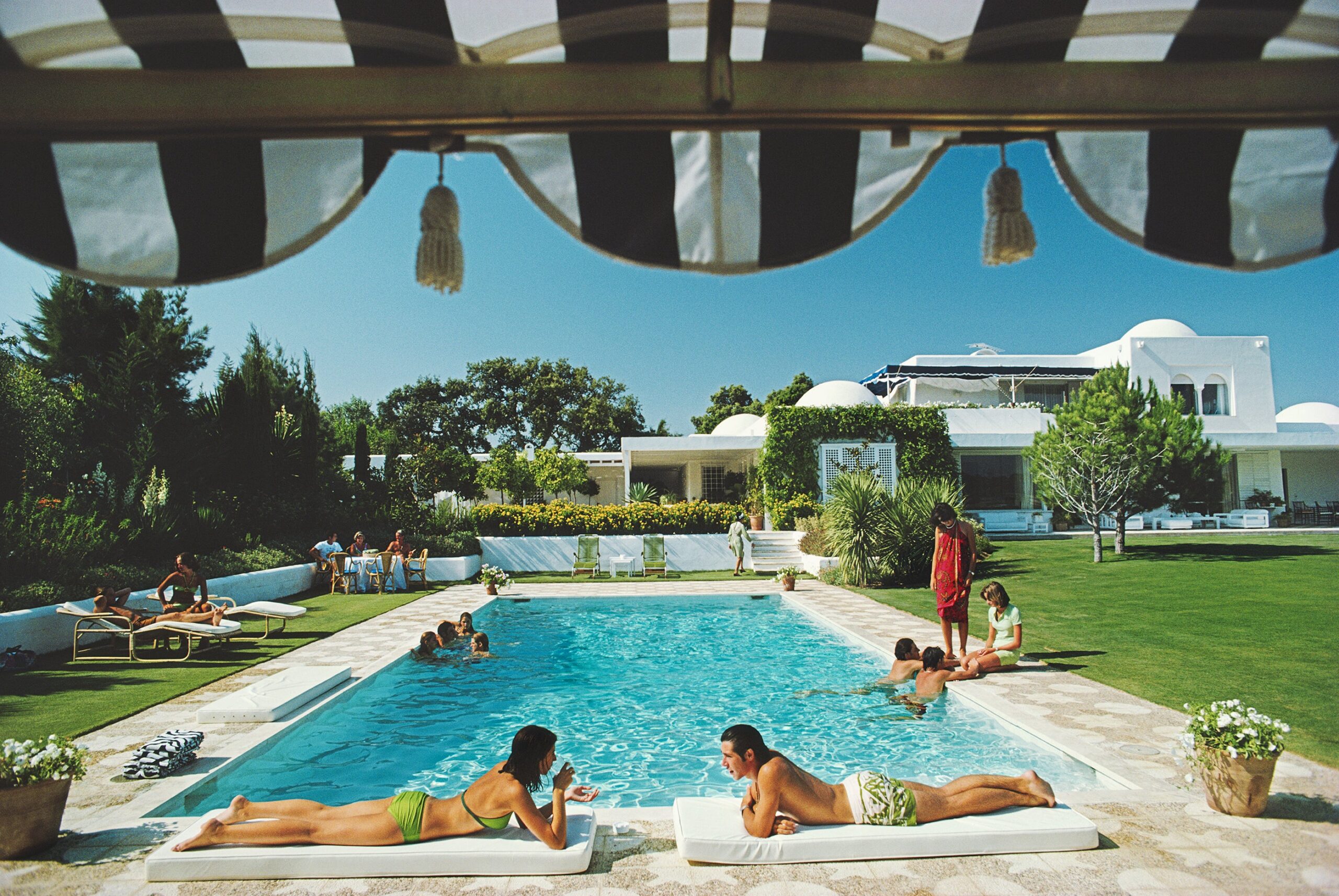
For decades, Slim Aarons (1916–2006) photographed a world most people only imagined from the outside: the pools, terraces, and villas of the postwar elite. He worked on assignment for Holiday, Life, and Town & Country, and the pictures that once filled those magazines now stand as one of the most compelling bodies of photographic work of the twentieth century.
The Life and Work of Slim Aarons
Born in New York City in 1916, Aarons served as a combat photographer during the Second World War and was awarded a Purple Heart. He returned with a clear and deliberate ambition: to photograph, in his own words, “attractive people doing attractive things in attractive places.” It became the governing principle of a career spent among the postwar leisure class.
He photographed his subjects at rest: beside the pools of Palm Springs, on Mediterranean terraces, and inside the villas of the international set. The pictures look effortless, but little in them was left to chance. Aarons composed each frame with care, in a sun-filled, understated style that treated glamour as a subject worthy of serious attention. His access came from trust. Welcomed into these circles as a guest rather than an outsider, he photographed a naturalness that no posed session could reproduce.
Why Aarons’ Work Endures
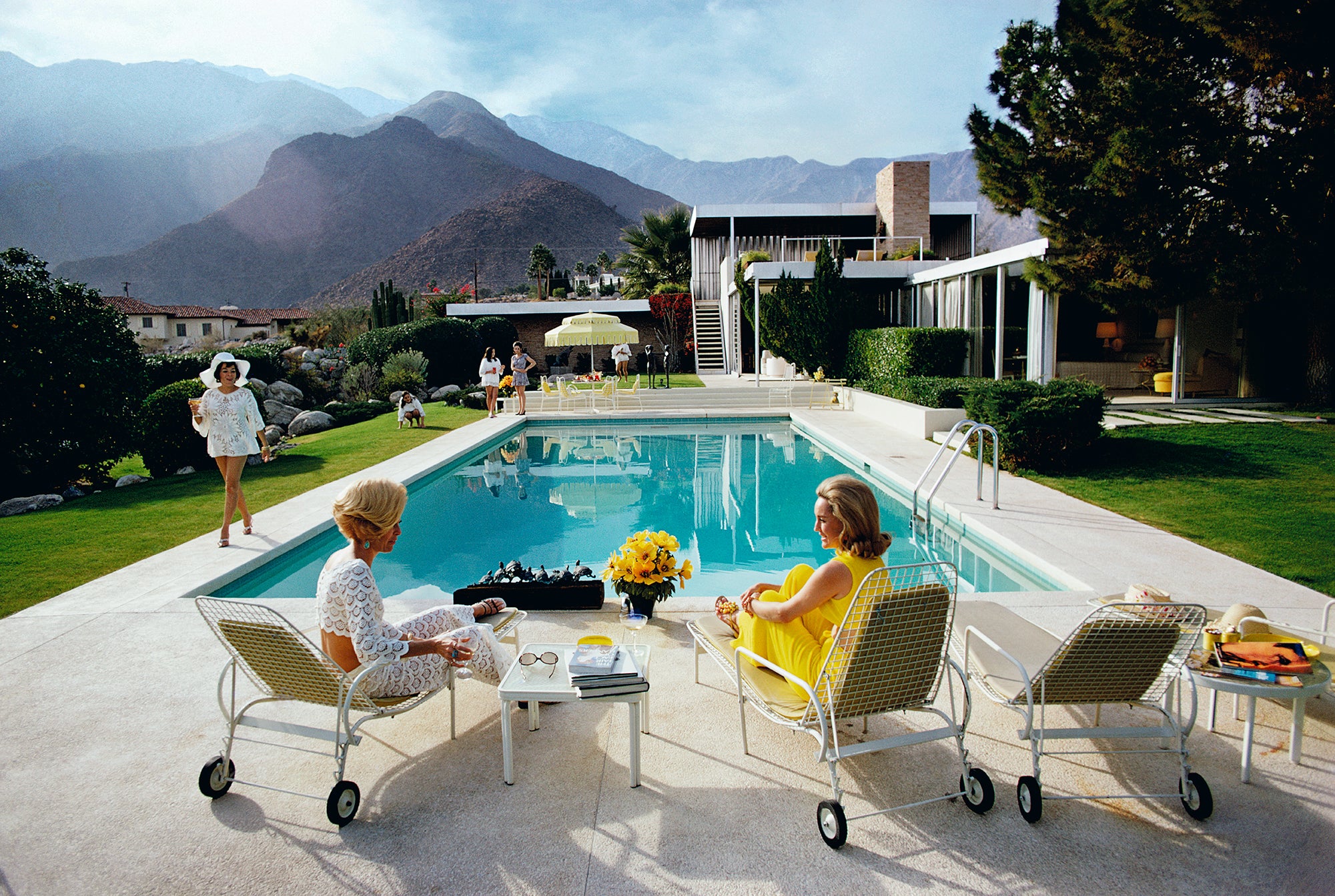
Aarons’ work endures because it is at once glamorous and historical. He worked in the tradition of environmental portraiture, photographing his subjects within the settings that defined their lives rather than against a studio backdrop. He shot in saturated color at a time when serious photography was still largely black and white. Certain of his images have become fixed in the visual memory of the century: Kings of Hollywood, his 1957 New Year’s Eve portrait of Clark Gable, Gary Cooper, Van Heflin, and James Stewart, and Poolside Gossip, made in Palm Springs in 1970. What began as magazine assignments now reads as a vivid and detailed record of a postwar world of leisure and privilege.
For much of his career, Aarons’ photographs were regarded as editorial work rather than fine art. His reputation was secured by his first gallery exhibition, held at Staley-Wise in New York in 2003, and by the monographs that followed it, including Once Upon a Time, A Place in the Sun, and Poolside with Slim Aarons. The market for his work has strengthened steadily since.
Slim Aarons in the Market
Getty Images, through its Hulton Archive, acquired Aarons’ archive in 1997. The market for his work rests principally on estate-authorized editions from that archive, stamped and numbered, rather than on vintage prints made in his lifetime. Authorized prints trade principally in the five figures, with his most celebrated images at the upper end of that range. Poolside Gossip, photographed at Richard Neutra’s Kaufmann Desert House, remains the image most closely associated with his name and among the most sought of his work.
Aarons holds a distinctive place in the photography market. Where the field’s blue-chip vintage names draw their value from scarcity, his rests on sustained international demand for authorized editions of instantly recognizable images, a structure that has made his market both broad and durable.
Collecting Slim Aarons
For collectors, Aarons offers immediate recognition on accessible terms. Because the market rests on authorized archival editions, documentation is central to value: an estate-stamped print is a materially different object from an unauthorized reproduction. Edition, print size, and condition all bear on price, and lifetime prints command a premium. A buyer who confirms the edition and the estate’s authorization can acquire one of the defining images of the twentieth century at an accessible price point.
Slim Aarons: A Wonderful Time, Ithaca’s online exhibition, runs through August 31. To acquire an Aarons print, or to discuss the work, contact an Ithaca advisor; every acquisition is handled privately. Contact us.