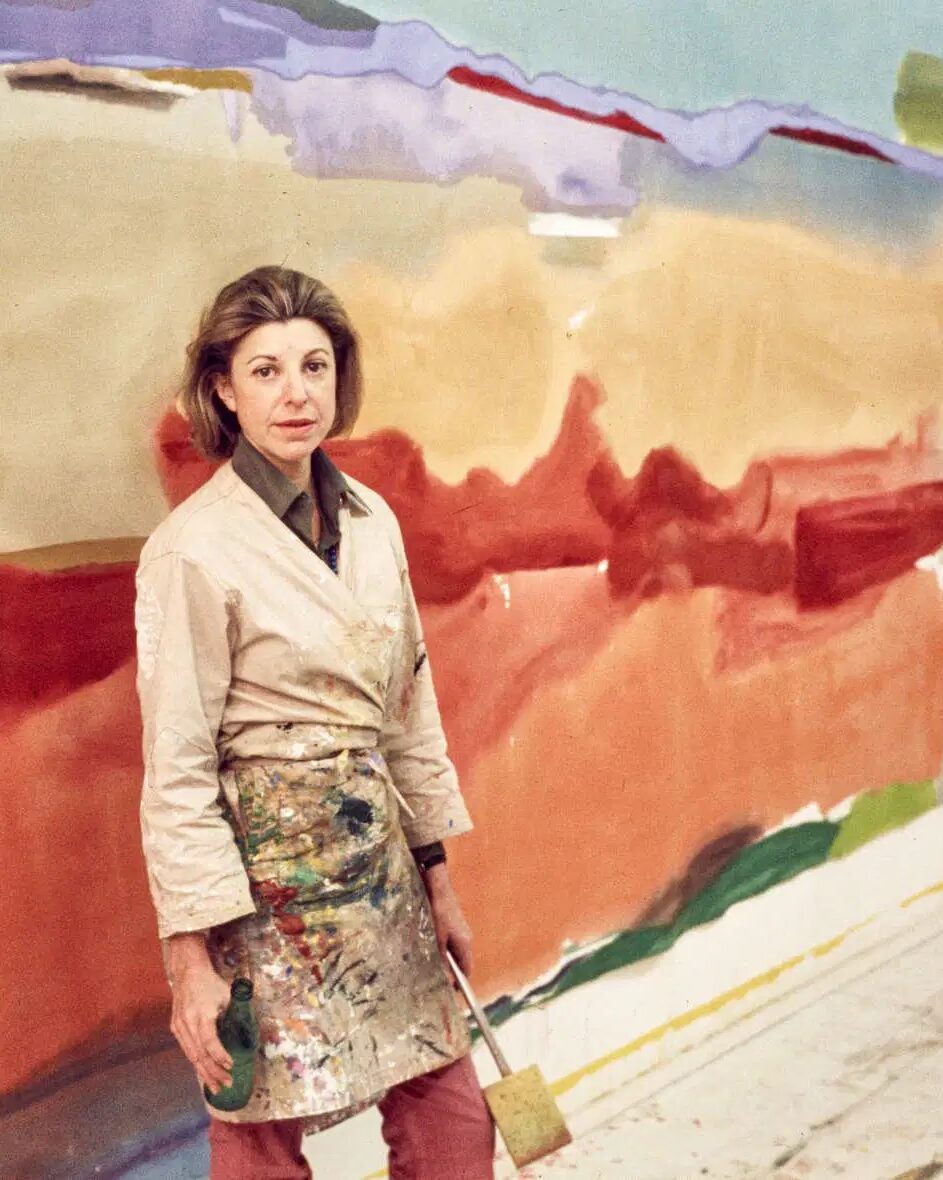
Helen Frankenthaler
Helen Frankenthaler (1928–2011, born New York City) was a painter of major importance to the development of postwar American abstraction, and is widely credited as one of the inventors of Color Field painting. Educated at the Dalton School under Rufino Tamayo and subsequently at Bennington College, she came of age artistically in the milieu of Abstract Expressionism, where the influence of Jackson Pollock proved decisive.
In 1952, Frankenthaler created Mountains and Sea, a breakthrough work in which she poured thinned paint directly onto raw, unprimed canvas laid flat on the studio floor, producing floating fields of translucent colour that seemed to fuse image and surface into a single continuous thing. The technique, which she called soak-stain, was immediately influential, inspiring Morris Louis and Kenneth Noland to develop what became known as the second generation of Color Field painting. Active for nearly six decades, Frankenthaler continued to expand her practice across painting, printmaking, ceramics, and tapestry, producing a body of work whose range and quality have only continued to grow in critical standing since her death.
She was the subject of major retrospectives at the Whitney Museum of American Art, the Solomon R. Guggenheim Museum, and the Museum of Modern Art, New York. Her work is held in collections worldwide.