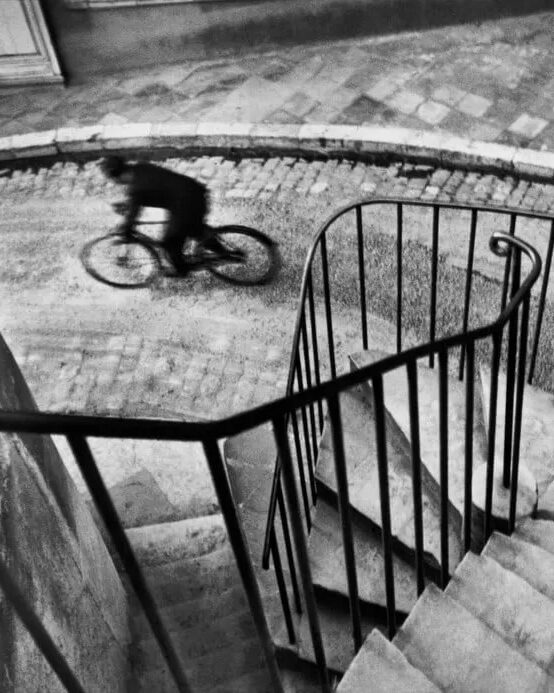
Henri Cartier-Bresson
Henri Cartier-Bresson (1908–2004, born Chanteloup, France) was a photographer, filmmaker, and co-founder of Magnum Photos whose concept of the decisive moment transformed the understanding of photography and helped establish photojournalism as a serious art form. Initially trained as a painter under the Cubist André Lhote and deeply influenced by Surrealism, Cartier-Bresson came to photography in the early 1930s, acquiring his first Leica in 1933 and quickly developing the approach of alert, unobtrusive observation for which he became celebrated.
Working exclusively in black and white with available light, he produced over five decades a body of documentary work of extraordinary range, covering the Spanish Civil War, the death of Gandhi, the Chinese Civil War, and the protests of May 1968, alongside intimate portraits of Picasso, Matisse, and Giacometti. In 1947 he co-founded Magnum Photos with Robert Capa, George Rodger, and David Seymour. His book The Decisive Moment, published in 1952, remains one of the most important texts in the history of photography.
His work is held in the collections of the Museum of Modern Art, New York, the Bibliothèque Nationale de France, and the Fondation Henri Cartier-Bresson in Paris.