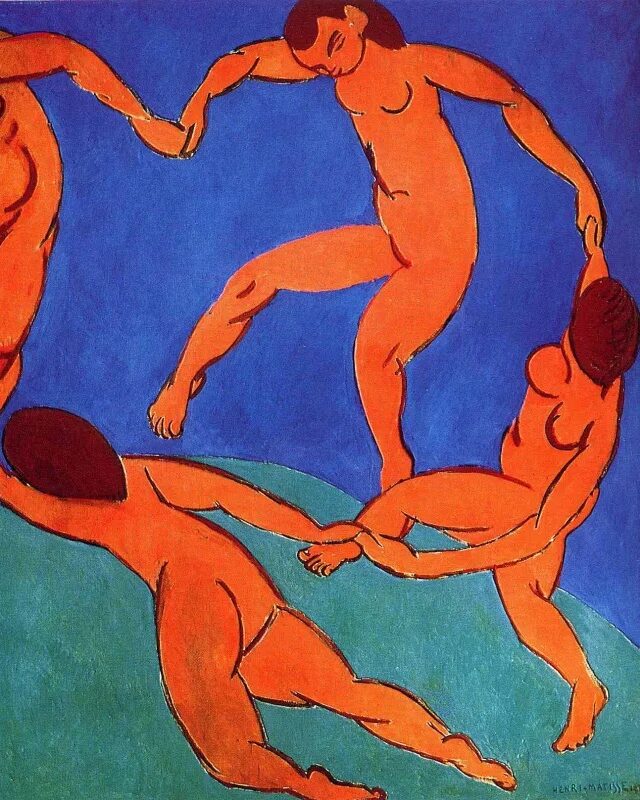
Henri Matisse
Henri Matisse (1869–1954, born Le Cateau-Cambrésis, France) was a painter, draughtsman, printmaker, and sculptor whose revolutionary use of colour and his development of a simplified, expressive line made him, alongside Picasso, the most significant artist of the first half of the twentieth century. Turning to painting in his early twenties following a period of illness, Matisse quickly established himself as a leading figure of Fauvism, the movement characterised by an intense, non-naturalistic use of colour that shocked audiences at the 1905 Salon d’Automne.
His work evolved with remarkable consistency and ambition across five decades, from the monumental figure compositions and bold decorative interiors of his early career to the warmly luminous paintings of his Nice period in the 1920s, and finally to the radical cut-paper works of his final years, the Gouaches Découpées, produced when illness prevented him from painting. These late works, including the celebrated Jazz series (1947) and the decorations for the Chapel of the Rosary at Vence, represent the culmination of a lifetime’s investigation into colour, form, and the nature of pictorial space, and are now recognised as among the most original achievements of his career.
His work is held in virtually every major museum collection in the world, with particular depth at the Musée Matisse in Nice, the Hermitage in St. Petersburg, and the Museum of Modern Art, New York.