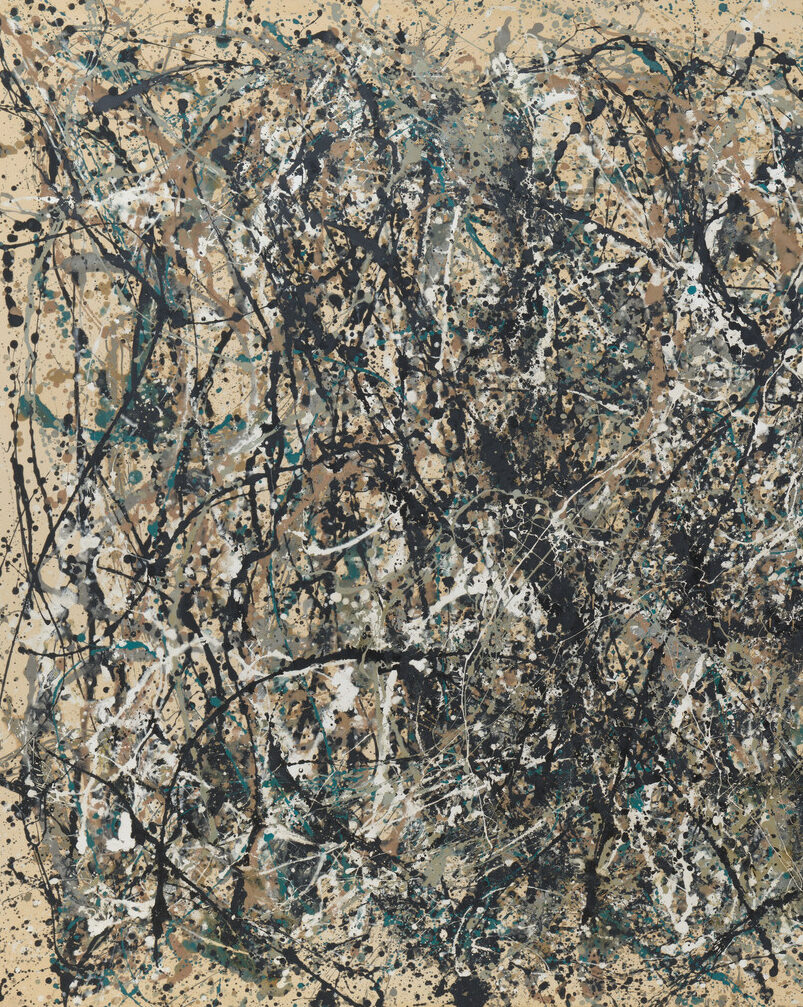
Jackson Pollock
Jackson Pollock (1912–1956, born Cody, Wyoming) was a painter whose development of the drip technique in the late 1940s placed him at the forefront of Abstract Expressionism and changed the history of American art. Raised in Arizona and California before moving to New York in 1930, he studied under Thomas Hart Benton and came of age artistically in the milieu of the Works Progress Administration, where he encountered the work of the Mexican muralists and the European Surrealists, both of which proved formative.
Between 1947 and 1950, Pollock developed the technique for which he is most celebrated: placing his canvas on the floor and moving around and across it, pouring and dripping paint in sweeping gestural arcs that produced canvases of extraordinary physicality and scale. Works from this period, including Number 31 (1950) and Autumn Rhythm (1950), are among the canonical achievements of postwar art. Critical recognition came quickly, though Pollock’s struggles with alcoholism persisted throughout his life. He died in a car accident in East Hampton, New York in 1956 at the age of forty-four.
His work is held in the permanent collections of the Museum of Modern Art, New York, the Metropolitan Museum of Art, and the Smithsonian American Art Museum, among many others.