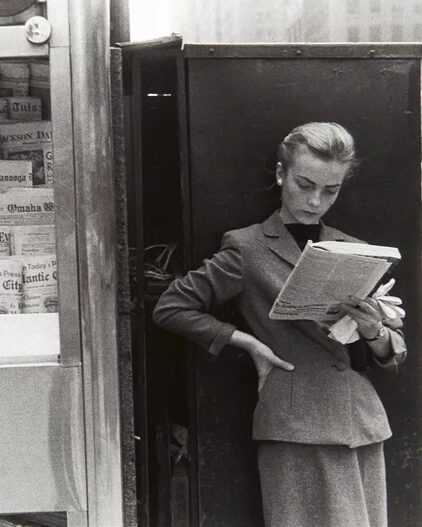
Louis Stettner
Louis Stettner (1922–2016, born Brooklyn, New York) was a photographer whose seven-decade career produced a body of work defined by an abiding humanism and a poetic attentiveness to the lives of ordinary people in the two cities he called his spiritual homes, New York and Paris. Drawn to photography as a teenager through visits to the Metropolitan Museum of Art and the galleries of Alfred Stieglitz, Stettner served as a combat photographer in the Pacific during the Second World War before moving to Paris in 1947, a three-week trip that extended into five years.
In Paris he studied film at the Institut des Hautes Études Cinématographiques and developed close friendships with Brassaï, Willy Ronis, and Robert Doisneau. These relationships deepened his understanding of the French humanist tradition while sharpening the directness and social consciousness of his American eye. Returning to New York in the early 1950s, he documented the city’s workers, commuters, and public spaces with a gravity and tenderness that set his photographs apart from the more aggressive energy of much contemporary street photography. He moved permanently to Paris in 1990 and continued photographing both cities until his death. In 2001 he was awarded the Chevalier de l’ordre des Arts et des Lettres by the French government.
His work is held in the collections of the Centre Pompidou, Paris, the Metropolitan Museum of Art, and the Bibliothèque Nationale de France.