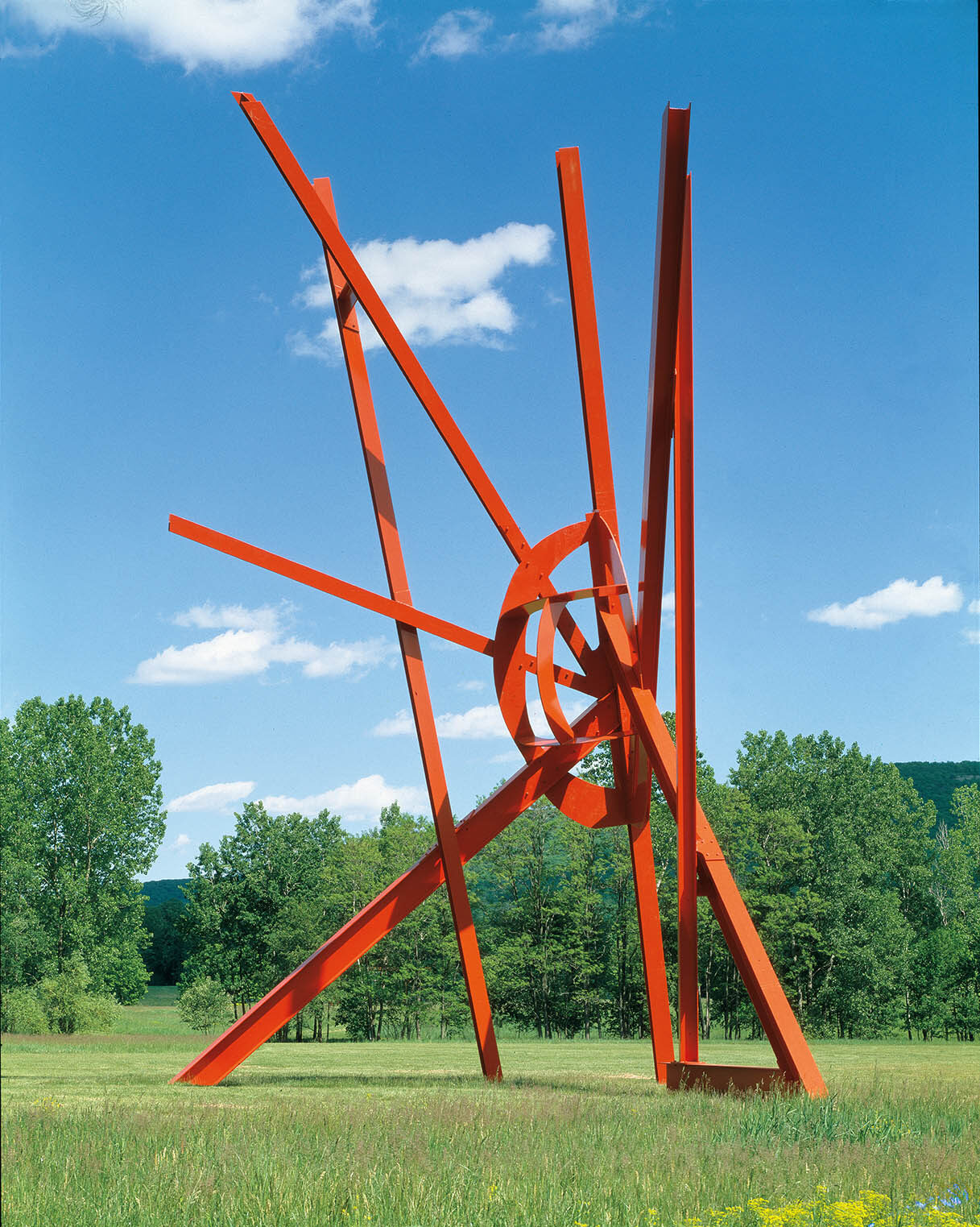
Mark di Suvero
Mark di Suvero (born 1933, Shanghai, China) is a sculptor whose monumental steel constructions, built from industrial materials and animated by kinetic elements that invite physical interaction, established him as one of the most important sculptors to emerge from the Abstract Expressionist era. Born in Shanghai to Italian parents and raised in San Francisco after his family emigrated to the United States in 1941, di Suvero studied philosophy at the University of California, Berkeley, before moving to New York in 1957.
A near-fatal elevator accident in 1960 that left him temporarily paralyzed proved a defining moment. During his recovery he learned to weld and began developing the large-scale, crane-assisted steel sculpture for which he became celebrated. Drawing on the gestural freedom of Abstract Expressionism and translating it into three-dimensional space through angled beams, swinging elements, and industrial forms of imposing scale, his work brought sculpture into genuine dialogue with its surrounding landscape and its audience. A committed activist, he left the United States in 1971 in protest against the Vietnam War and became the first living artist to exhibit in the Tuileries Gardens in Paris in 1975.
His work is held in permanent installations and collections internationally, including the Storm King Art Center, the Whitney Museum of American Art, and the National Gallery of Art Sculpture Garden, Washington D.C. He was awarded the National Medal of Arts in 2010.