
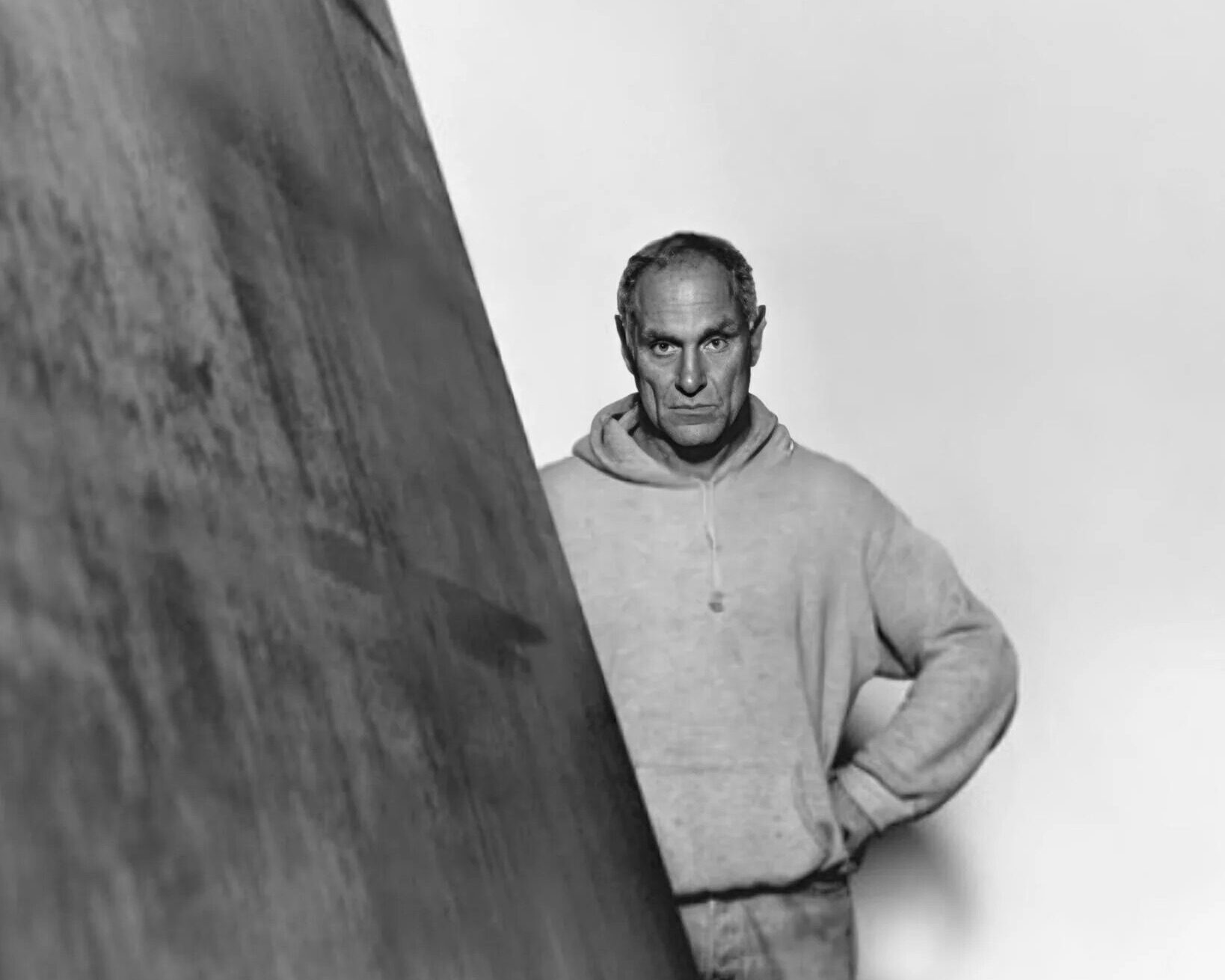
Richard Serra (1938–2024) is widely regarded as the most consequential sculptors of his generation, an artist who lifted sculpture from the pedestal and relocated its meaning to the charged encounter between viewer, material, and site. Emerging from Minimalism but pressing decisively beyond it, he made weight, load, and gravity the explicit subject of his work, and the viewer’s movement its essential medium. To stand before a Serra is not to contemplate an object held at a distance but to be drawn into a field of mass and space, where perception unfolds over time and the work discloses itself only through movement. Across six decades, from molten lead hurled against a gallery wall to plates of weatherproof steel weighing many tons, he pursued a single, uncompromising proposition: that sculpture is an experience to be lived.
The Life and Work of Richard Serra
Born in San Francisco on November 2, 1938, Serra was the son of a Spanish immigrant who worked as a pipefitter in the city’s shipyards. He often traced his art to a single early memory: on his fourth birthday, he watched a tanker launch from the yard, a vast steel hull sliding from land into water. The properties of mass, the mechanics of equilibrium, and the profound kinetic potential of weight in motion would remain the central subjects of his work.
Serra worked in steel mills to pay for his studies, and steel never left his art. He earned a degree in English literature from the University of California, Santa Barbara, in 1961, then took both a BFA and an MFA at Yale by 1964. There he studied under Josef Albers and worked alongside Brice Marden, Chuck Close, and Nancy Graves. Fellowships carried him to Paris, where he returned often to Brancusi’s studio, and then to Florence. He settled in New York in the mid-1960s, among friends who included Philip Glass, Steve Reich, and Robert Smithson.
The Pursuit of Material
Serra’s early work proposed a radical economy of means. The Verb List (1967–68), a handwritten inventory of transitive actions beginning with “to roll, to crease, to fold,” outlined a program for an art generated not through composition or representation but through the direct application of process to matter itself. He enacted these propositions with startling literalness: hurling molten lead into the seam where wall meets floor in the Splashing and Casting works, and propping four lead plates into a precarious equilibrium, held solely by their own mass, in One Ton Prop (House of Cards) (1969).
These works placed Serra at the center of post-minimalism and established the principles that would govern his practice for the next half century. Material was to be presented on its own terms, never in the service of illusion or image. Gravity, rather than the artist’s hand, would become the agent of construction, and weight itself was to be understood not as a property of sculpture but as its very subject. “Weight is a value for me,” Serra later wrote, describing balancing, propping, leaning, and disequilibrium as the essential grammar of his practice. A plate of steel, in his hands, remained unequivocally a plate of steel, declaring its load, its lean, and its capacity to both threaten and shelter. This insistence on the irreducible reality of materials became one of the defining propositions of postwar sculpture and laid the foundation for the monumental steel environments that would follow.
Major Works and Defining Periods
During the 1970s, Serra moved decisively beyond the confines of the gallery and into landscape and the city, adopting weathering steel, a material that oxidizes to form a stable, protective patina. Sited with exacting precision, his monumental arcs and plates were conceived to choreograph movement, measure distance, and render the surrounding environment newly legible to the walking body. Sculpture became inseparable from place itself, a conviction that would define his practice and, in time, embroil it in one of the most consequential controversies in the history of public art.
From the 1990s the Torqued Ellipses carried that ambition indoors and into pure phenomenology. Spiraling walls of steel that lean inward and outward as one advances, they dissolve any settled sense of orientation; their geometry, which Serra traced to the disorienting curved volume of Borromini’s Baroque church of San Carlo alle Quattro Fontane in Rome, could be realized at full scale only on steel-bending machinery built for the construction of ships. Walking through them, one registers not their immense tonnage but, as Serra said of the related spirals, “their speed and their movement.” The most powerful concentration of these works resides permanently at Dia Beacon.
His ambitions culminated in installations of architectural permanence. The Matter of Time (1994–2005), a sequence of eight monumental sculptures conceived for the Guggenheim Bilbao, orchestrates an extended passage through curving, vertiginous corridors of steel and stands among the defining environments of postwar art. Late in his career, East-West/West-East (2014) set four towering plates across the gypsum desert of Qatar, their summits held in perfect level against the horizon. The Museum of Modern Art devoted a major retrospective to his sculpture in 2007, and the Metropolitan Museum of Art examined his equally serious practice as a draftsman in 2011.
No work tested the conviction of site-specificity more severely than Tilted Arc. Commissioned by the federal government and installed across Manhattan’s Federal Plaza in 1981, it was a single arc of weatherproof steel, 120 feet long and 12 feet high, that bisected the plaza and compelled everyone who crossed it to reckon with its presence. Objections mounted, a public hearing was convened in 1985, and in 1989 the sculpture was cut apart and carried away. Serra refused every proposal to relocate it, on the principle that a site-specific work cannot be moved without being destroyed. “The experience of the work is inseparable from the place in which the work resides,” he insisted; “to remove the work is to destroy it.” The episode became the defining case in the modern history of public art, a confrontation between the autonomy of the artist and the claims of civic space whose terms are still debated.
Why Richard Serra Matters
Serra’s importance rests on a fundamental reordering of his discipline. He severed sculpture from representation and from the pedestal that had long held it apart from the world, and he reattached it to the contingencies of weight, scale, duration, and the perceiving body. The content of a Serra is not a form to be decoded but an experience to be undergone, one that enlists the viewer to walk, to slow, to lose and recover their bearings, and to feel the body register the load of steel held in balance. In doing so he proposed the construction of spaces that “contribute something to the experience of who we are.” Few artists of the past century altered so completely the terms on which their medium is understood. His work is held by virtually every major collection of postwar and contemporary art, among them the Museum of Modern Art, the Solomon R. Guggenheim Museum, the Metropolitan Museum of Art, Dia, the Broad, and Tate.
Richard Serra in the Art Market
Serra’s market is governed by a defining paradox: the works that secured his reputation are, by their very nature, the least available to private hands. The monumental sculptures are overwhelmingly site-specific and institutionally held, conceived as permanent commissions rather than as objects to be traded. Among his highest results at auction is a comparatively portable steel work, LA Cone (1986), which realized $4,267,750 at Christie’s New York in 2013.
For the collector, the meaningful field lies elsewhere, above all in the drawings and works on paper, where dense, saturated fields of black paintstick achieve a sculptural gravity entirely their own. Leading examples have surpassed $1 million, and a major oilstick drawing sold for roughly $2 million at Frieze Los Angeles in 2024. His prints and editions, in particular the deeply worked etchings that translate the language of the sculpture onto paper, offer a more accessible and historically grounded point of entry. As throughout the blue-chip postwar sector, provenance, condition, and documentation remain the decisive determinants of value.
Collecting Richard Serra
Gallery Ithaca advises collectors on acquisitions, private sales, collection management, and market strategy across the postwar and contemporary sectors. For inquiries regarding Richard Serra works, or to discuss building a collection of significance, contact info@galleryithaca.com.