Robert Mapplethorpe (1946–1989) occupies a singular place in the history of twentieth-century photography. Across a career spanning less than two decades, he produced a body of work that fundamentally reshaped contemporary portraiture and expanded the boundaries of photography. Drawing deeply upon the traditions of classical sculpture, Mapplethorpe approached photography through an enduring, almost architectural obsession with form.
Working primarily in black and white, Mapplethorpe applied the same unwavering visual discipline to every subject. Flowers, celebrity portraits, and the human figure all became vessels through which he explored timeless ideals of beauty, symmetry, and proportion. Today, his photographs remain among the most iconic images of the late twentieth century, continuing to exert a profound influence on contemporary visual culture. His work is held in the permanent collections of major museums worldwide, including the Museum of Modern Art, the Solomon R. Guggenheim Museum, the Whitney Museum of American Art, and the J. Paul Getty Museum.
The Life and Work: From Pratt Institute to Photography
Born on November 4, 1946, in Floral Park, Queens, Mapplethorpe’s foundational training was rooted in the fine arts. He studied painting, drawing, and sculpture at Brooklyn’s Pratt Institute from 1963 to 1970. During his student years, he worked primarily in collage and mixed media before turning his attention toward photography.
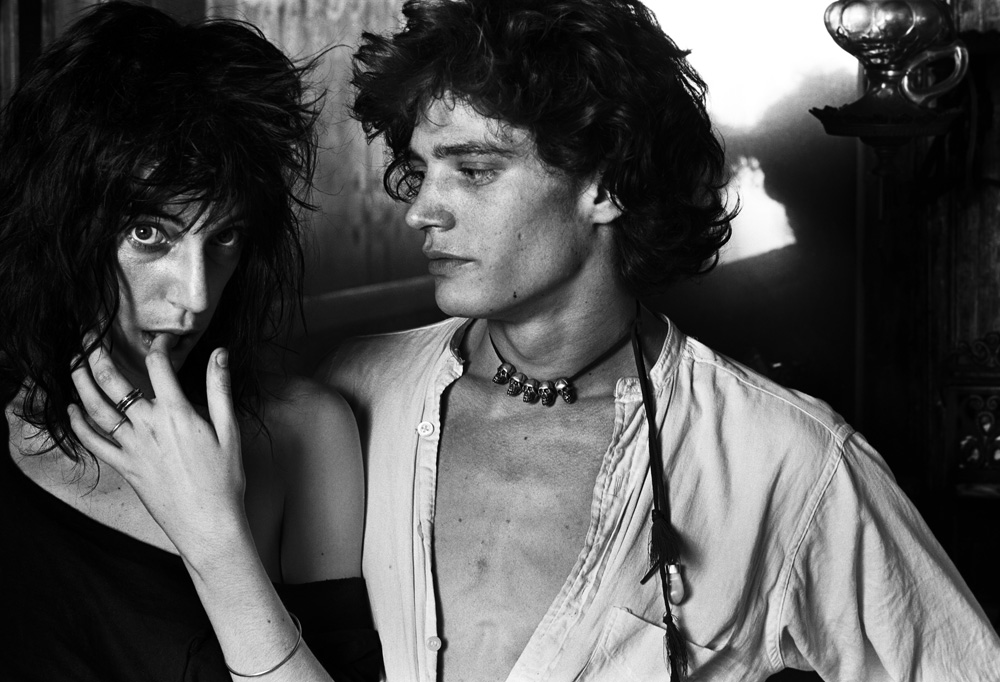
A pivotal moment came in 1970 when filmmaker Sandy Daley gave him a Polaroid camera. Photography soon became central to his practice, providing a medium through which he could pursue many of the artistic concerns that had emerged in his earlier work. Mapplethorpe met Patti Smith in 1967, beginning a relationship that would become one of the most significant creative partnerships of their generation. Living together at the Chelsea Hotel during the early 1970s, they documented one another during formative years in New York’s avant-garde. His portrait of Smith, later used for the cover of her 1975 album Horses, remains one of the defining photographic portraits of the period.
By the late 1970s, Mapplethorpe had established himself as one of the leading photographers of his generation, exhibiting widely throughout the United States and Europe.
The Pursuit of Form
At the absolute center of Mapplethorpe’s practice was an unyielding interest in form. His early training in sculpture shaped his entire understanding of photography, viewing the photograph not just as a captured moment, but as a carefully constructed image.
Whether framing an orchid, a cultural icon, or a studio nude, Mapplethorpe distilled his subjects to their essential geometry. His photographs emphasize structure, inviting viewers to engage with the pure formal qualities of light and shadow. This commitment to order remained remarkably consistent across his entire oeuvre. Flowers were treated with the same graphic rigor as portraits, and still lifes received the same meticulous attention as human anatomy, creating a highly unified visual language.
To achieve this level of perfection, Mapplethorpe worked closely with master printer Tom Baril from 1979 onward. Exercising an extraordinary degree of control over the final print, the physical object itself became a vital component of the artwork, celebrated for its rich tonal range and pristine execution.
Major Bodies of Work
Mapplethorpe’s oeuvre is largely defined by three recurring subjects, each serving as a unique vehicle for his formal inquiries:
The Human Figure: The body was perhaps where Mapplethorpe most fully realized his fascination with classical Greco-Roman ideals. His nudes reveal a sculptural approach that emphasizes muscle, contour, and balance. While some of these works generated intense cultural controversy during his lifetime, they are now universally recognized for their technical mastery and their historic contribution to figurative art.
Portraiture: Throughout the 1970s and 1980s, Mapplethorpe photographed the cultural vanguard of his time, including Andy Warhol, Truman Capote, and Louise Bourgeois. Characterized by their graphic precision and quiet intensity, these images transcend conventional celebrity photography, becoming enduring studies of presence and identity. His introspective self-portraits are equally significant, charting his own evolution and, later, his mortality.
Botanicals: Orchids, tulips, and lilies became subjects through which he explored line, texture, and symmetry. Rendered with isolated, dramatic lighting, these photographs elevate familiar flora into highly refined, sculptural compositions that blur the line between still life and abstraction. Today, they are among the most sought-after works in his market.
Cultural Flashpoints and Legacy
In 1986, Mapplethorpe was diagnosed with AIDS. He continued working with remarkable resolve through the final years of his life, establishing the Robert Mapplethorpe Foundation in 1988 to preserve his archive and support medical research for HIV/AIDS.
Following his death in 1989, public debate surrounding the provocative nature of his work intensified. That same year, the Corcoran Gallery of Art canceled the Washington presentation of his major retrospective, The Perfect Moment. When the exhibition traveled to Cincinnati in 1990, it sparked a landmark criminal trial over artistic freedom and censorship. The subsequent acquittal established the moment as a watershed event in the history of American art and public funding.
While these controversies remain an indelible part of his history, they represent only one facet of a vast legacy. Today, curators and collectors celebrate Mapplethorpe’s pure contribution to the medium, securing his permanent place within the modern canon.
Robert Mapplethorpe in the Fine Art Market
Mapplethorpe’s photographs have maintained a commanding, stable presence in the international art market for decades. Blue-chip demand remains heavily concentrated around his iconic flower studies, definitive portraits, and rare vintage prints.
His current auction benchmark was established at Christie’s when a rare platinum print of his 1988 Self-Portrait sold for £548,750, underscoring the premium placed on tight edition sizes and exceptional print mediums. While his exquisite platinum prints command the highest tier of the market due to their rarity, his lifetime gelatin silver prints form the solid foundation of collector demand worldwide.
Collecting Robert Mapplethorpe
As one of the most influential photographers of the twentieth century, Robert Mapplethorpe remains a cornerstone figure for both established and emerging fine art collections.
Ithaca Gallery facilitates the acquisition, sale, and strategic placement of masterworks of twentieth-century photography. To discuss acquisitions, private consignments, or current market opportunities, please contact the gallery.